
How to raise lawn care prices at renewal without losing good accounts
When to send the increase, how much to raise each account, the margin math, and three letters you can copy.
Last updated November 5, 2026.
The short answer
Send the new price before the customer commits to the next season or term. About 45 to 60 days ahead is common, and 30 days is the shortest notice most companies give. There is no standard percentage. Work out what each visit costs you, then price it so you keep your target margin: price = cost ÷ (1 − target margin). Accounts already at target need a small adjustment. Accounts below it need more, or a smaller scope.
When to send the increase
Send it before the customer commits to the next season or term, so the new price is part of the decision rather than a surprise on the first bill. About 45 to 60 days ahead is common, and 30 days is the shortest notice most companies give. This is common practice, not a law. Check your own contract for any notice period it sets.
| Service | When to send |
|---|---|
| Weekly maintenance | 45 to 60 days before your first visit of the season |
| Fertilization and treatment programs | Before the first application, with the program renewal |
| Monthly flat-fee service | At least 30 days before the first month at the new price |
| Seasonal snow | Before the snow agreement is signed for the coming winter |
| Commercial accounts | As the agreement says: many set their own notice period and renewal date |
In year-round markets, such as much of the South, the Southwest and the West Coast, there is no off-season. Renewals follow each contract’s anniversary, so send each letter 45 to 60 days before that account’s date rather than all at once.
How much to raise each account
There is no standard percentage that fits every account. The right increase is the one that brings each account to your target margin, and that is different for every account.
Work out the cost per visit
Cost per visit = crew hours on site × your fully burdened hourly cost, plus materials and fuel. The fully burdened hourly cost is wages plus payroll taxes, workers’ compensation, insurance and the equipment and overhead each crew hour has to carry. Landscape Management explains one way to recover overhead in the hourly rate.
Margin is not markup
Margin is the share of the price you keep: (price − cost) ÷ price. Markup is what you add to cost: (price − cost) ÷ cost. A 35% markup is only a 26% margin. To hit a target margin, divide by (1 − target margin) rather than multiplying cost by (1 + margin). NALP covers the difference between markup and margins.
A worked example
Illustrative numbers.
- Today’s price: $55 a visit.
- Cost: 0.75 crew-hours at a fully burdened $48 an hour is $36, plus $4 of fuel and materials, so $40 a visit.
- Margin today: ($55 − $40) ÷ $55 = 27%.
- Price for a 35% target margin: $40 ÷ (1 − 0.35) = $61.54. Round it to $62.
- At $62 the increase is 13%, and the margin is 35.5%.
Group accounts by margin, not by street
A single percentage for everyone over-raises the accounts that are already profitable and under-raises the ones that are not. Sort your accounts by margin against your target and set a rule for each group: a small adjustment for accounts at or above target, a larger one for accounts below it, and a scope conversation for accounts that cannot reach target at any price the customer will pay.
Three letters you can copy
Put the new price and the date it starts in the first two sentences. Give one specific reason, say what stays the same, say how to reach you, and close with a short thank-you. Leave out “due to market conditions”, apologies, and any discount in the same letter.
1. The standard annual adjustment
Dear [Customer name],
Starting [date], your weekly lawn care will be [$new] a visit, up from [$old]. The change reflects higher wages for our crews this year.
Your service stays the same: the same crew, the same day of the week, and mowing, trimming, edging and cleanup at every visit.
If you have questions, call or email me at [phone] or [email].
Thank you for having us look after your property.
[Your name], [Company]
2. An account below target, with scope options
Dear [Customer name],
Starting [date], your service will be [$new] a visit, up from [$old]. Fuel and insurance for our trucks and equipment have gone up, and your price has not changed in [number] years.
If you would rather keep your cost closer to what it is now, there are two options:
- Visits every other week in [slow months], at [$option 1] a month.
- Mowing and trimming only, without edging and bed work, at [$option 2] a visit.
Let me know by [date] which you would prefer.
Thank you for being a customer.
[Your name], [Company], [phone], [email]
3. A commercial account
Dear [Contact name],
Under section [number] of our agreement for [property], we are giving notice that the price for the term starting [date] will be [$new] a month, up from [$old]. The change reflects wage and insurance costs for our crews.
The scope, schedule and service standards in the agreement stay the same.
If you would like to review the scope before renewal, or need anything for your budget, contact me at [phone] or [email].
Thank you for the work together.
[Your name], [Title], [Company]
Handling replies and pushback
When a customer pushes back, offer a scope change before a discount: every-other-week visits in slow months, or dropping edging or bed work. A smaller scope keeps your margin; a discount gives it away. An account that cannot reach your margin at any scope may be one to let go.
Make it a yearly routine
Raise prices every year rather than once every few years. Small yearly adjustments are easier to explain than a large catch-up increase. Set a date on your calendar to review margins, price each group, and send the letters, at the same point in every season.
Doing this in Capstone
The Renewals page, under Sales, shows each maintenance account’s margin for next year at today’s price against your target, once its renewal answers are filled in. A Below target view lists the accounts that need the most.
Tick a group, choose one rule for all of them (the price for target, an increase by a percentage, or the customer’s limit) and approve the prices together.
The Renewal letters page then shows each letter with the new price and the change from today’s, one letter to a page. Print them, then send the letters.
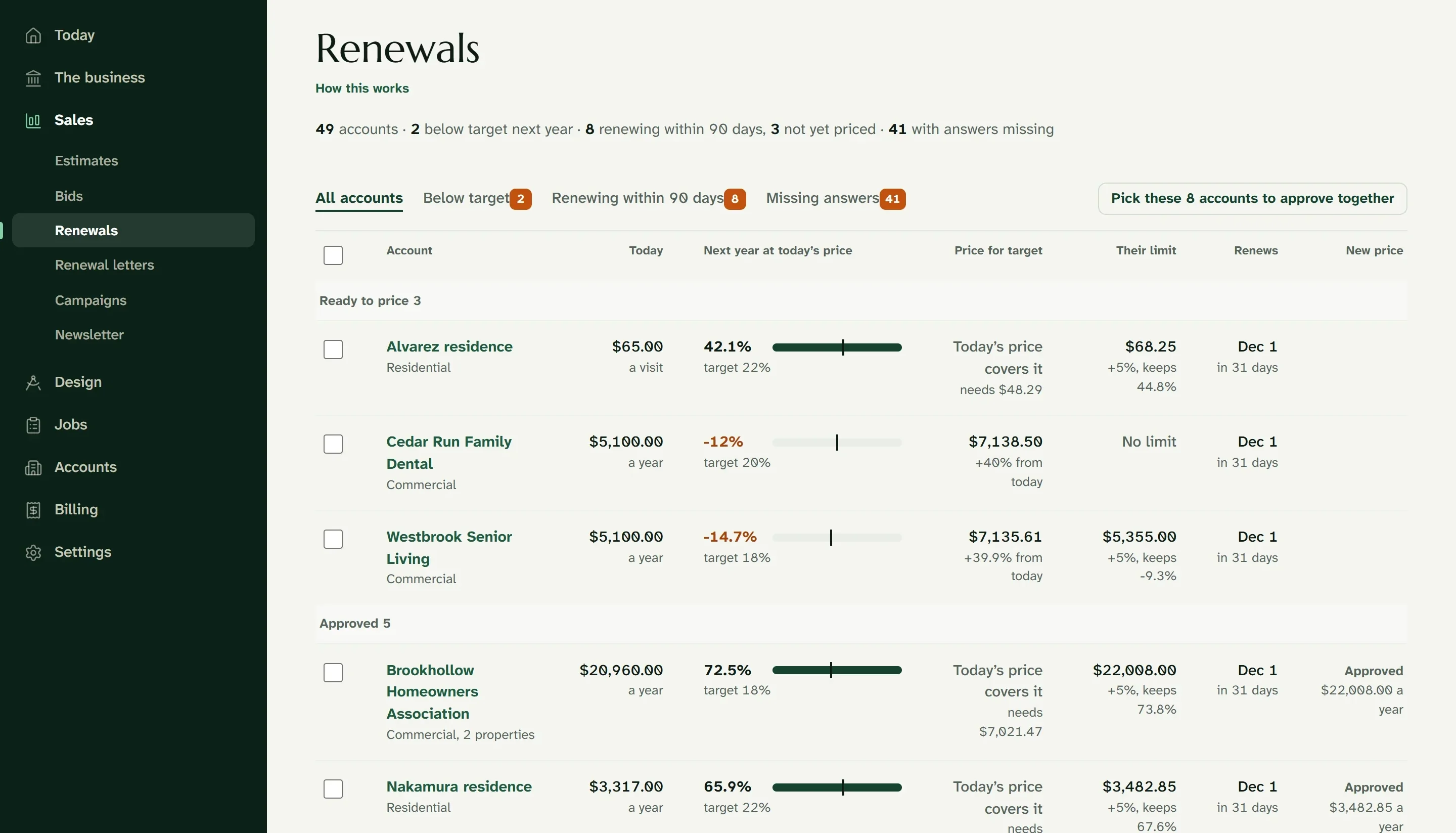
See how Capstone handles renewals through the year.
Questions
When should I send a lawn care price increase?
Before the customer commits to the next season or term. About 45 to 60 days ahead is common, and 30 days is the shortest notice most companies give. Commercial accounts follow their agreement. This is common practice, not law, so check your own contract.
How much should I raise lawn care prices?
There is no standard percentage. Work out each account’s cost per visit (crew hours × fully burdened hourly cost, plus materials) and set the price to cost ÷ (1 − target margin). Accounts at target need a small adjustment; accounts below it need more, or a smaller scope.
What should a price increase letter say?
The new price and the date it starts in the first two sentences, one specific reason such as wages, fuel or insurance, what stays the same, how to reach you, and a short thank-you. Leave out “due to market conditions”, apologies and a discount in the same letter.
What if a customer pushes back on the increase?
Offer a scope change before a discount, such as every-other-week visits in slow months or dropping edging or bed work. An account that cannot reach your margin at any scope may be one to let go.
Should every customer get the same percentage increase?
Not when their margins differ. Group accounts by margin against your target and set a rule for each group, so profitable accounts get a small adjustment and accounts below target get more.
Related: Switching landscape software without starting over.